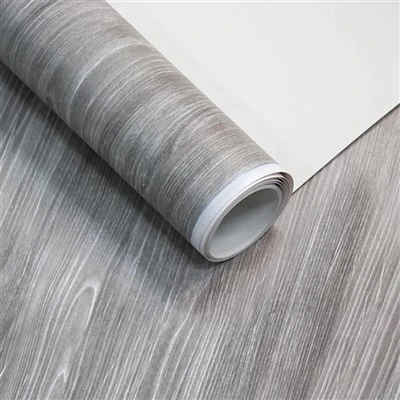
The most prominent distinction lies in their installation methods and convenience. Self-adhesive PVC decorative films are pre-coated with a layer of pressure-sensitive adhesive on the back, protected by a release liner. The installation process is straightforward and requires no professional tools or additional adhesives-users only need to peel off the release liner and paste the film directly onto the target surface. This "peel-and-stick" design makes it accessible to amateurs, such as homeowners and renters, allowing for quick renovations in a matter of hours. In contrast, non-adhesive PVC decorative films lack a pre-applied adhesive layer and rely on external glues, such as solvent-based or water-based adhesives, for bonding. Their installation demands professional skills: the substrate must be carefully cleaned and leveled, the adhesive evenly applied, and the film smoothed to avoid air bubbles and wrinkles. This process is more time-consuming and labor-intensive, often requiring the involvement of professional constructors.
Bonding stability and reusability are another pair of contrasting features. Self-adhesive films use pressure-sensitive adhesive, which offers immediate bonding upon application. However, the adhesive strength may diminish over time, especially in high-temperature, humid environments, or when applied to uneven surfaces, leading to edge lifting or peeling. Most self-adhesive films are designed for temporary or medium-term use; while some high-quality ones with removable adhesive can be repositioned, repeated peeling may reduce their stickiness and damage the substrate surface. Non-adhesive films, when paired with suitable professional adhesives, form a strong and permanent bond with the substrate. The adhesive penetrates the surface pores, ensuring long-term stability even in harsh conditions like kitchens and bathrooms. Once installed, non-adhesive films are not easily repositioned or removed, making them ideal for long-term decoration projects where durability is a priority.
Applicability to substrates and scenarios also varies between the two types. Self-adhesive PVC films perform best on smooth, clean, and dry surfaces, such as painted walls, glass, metal, and flat wooden furniture. They are not suitable for rough, porous, or dusty surfaces, as these can compromise bonding. Due to their easy installation and removability, they are widely used in rental apartments, temporary exhibitions, and small-scale home renovations, such as cabinet door makeovers, wall accents, and desktop decoration. Non-adhesive films, supported by professional adhesives, can adhere to a broader range of substrates, including rough cement walls, uneven wood, and textured surfaces. Their strong bonding and durability make them suitable for large-scale commercial projects, such as hotel lobbies, shopping mall interiors, and public facility renovations, as well as long-term residential applications like full-wall cladding and kitchen backsplashes.
Maintenance requirements and lifespan further highlight their differences. Self-adhesive films are relatively easy to maintain-daily cleaning with a damp cloth is sufficient to remove dust and stains. However, their lifespan is generally 3-5 years, as the adhesive layer is prone to aging and yellowing under UV radiation. Non-adhesive films, with their robust adhesive bond and better resistance to environmental factors, have a longer lifespan of 8-15 years. They also require minimal maintenance but are more difficult to remove if renovation is needed; removing them often involves scraping and cleaning the residual adhesive, which may damage the substrate and incur higher renovation costs.
In summary, self-adhesive and non-adhesive PVC decorative films cater to different decoration needs through their unique characteristics. Self-adhesive films excel in convenience, affordability, and flexibility, making them ideal for temporary, small-scale projects and amateur use. Non-adhesive films, on the other hand, offer superior durability, bonding strength, and applicability, suitable for long-term, large-scale commercial and residential projects. By considering factors such as installation budget, project duration, substrate type, and environmental conditions, one can make an informed choice between the two to achieve optimal decorative results.